What does the journey from social enterprise start-up to long-term impact really look like?
Ask almost any startup advisor or accelerator provider how a social enterprise should evolve, and you'll likely hear the same familiar playbook: launch, gain traction, attract investment and scale fast. It's an appealing, tidy narrative.
But a new report by Maastricht University, in collaboration with IKEA Social Entrepreneurship B.V., suggests the reality is far more complex.
Drawing on the experiences of nine social enterprises across Mexico, Colombia and Chile, the report
Contextualising the Entrepreneurial Journeys of Social Enterprises in Latin America challenges assumptions embedded in entrepreneurship support systems and offers new perspectives for funders, accelerators and ecosystem builders.
Beyond the linear growth story
"When we initiated this research, we had been supporting social enterprises for six years and could see that organisations could be categorised by their impact models," says Jens Andersson, Monitoring, Evaluation and Learning Specialist at IKEA Social Entrepreneurship. "We wanted to understand not just whether these models work, but how they work, why they work, and in which contexts."
But as discussions with the Maastricht University research team progressed, the focus shifted.
“For us, bringing context into the centre of the conversation was the interesting hook,” explains researcher Sergio Páramo. “Context is often used to explain why organisations started. We wanted to understand the role it plays in the day-to-day life of social enterprises.”
"But we were surprised to see just how much context shapes day-to-day decision-making through relationships with communities, customers, suppliers, partners and institutions,” adds Abel Díaz.
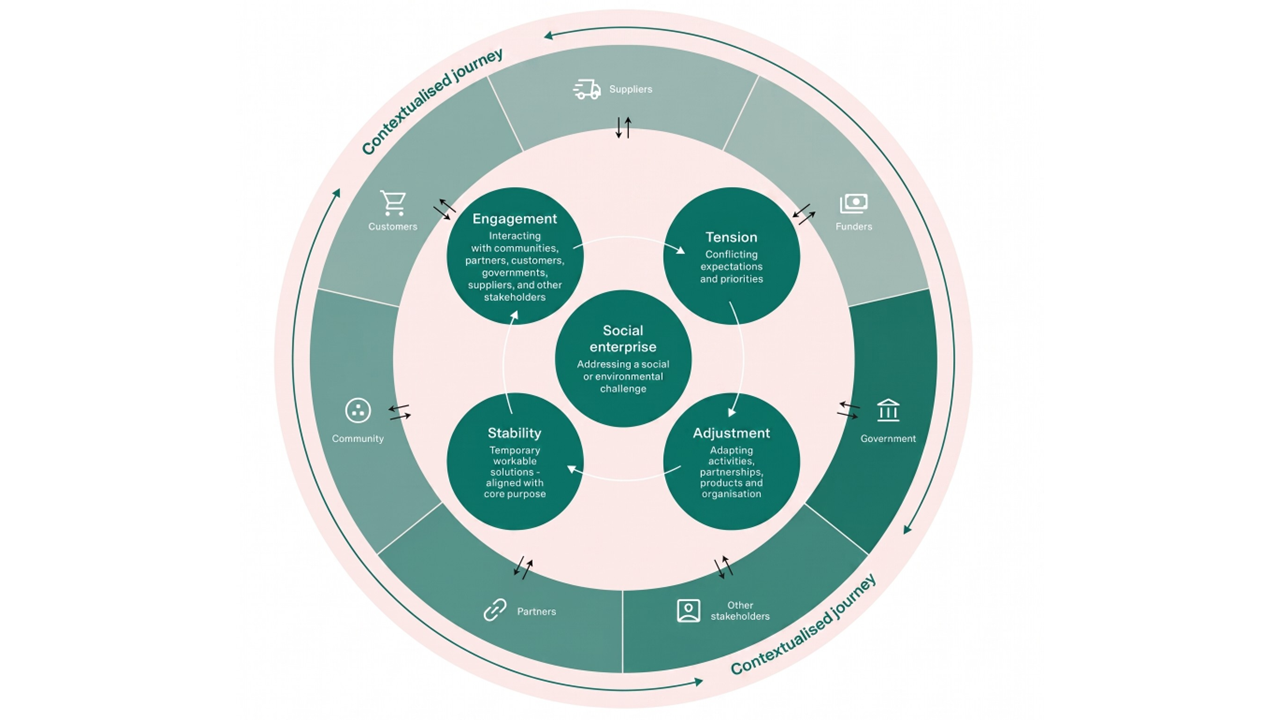
As researchers Sergio Páramo, Abel Díaz and Juliette Koning immersed themselves in the stories of social enterprises ranging from Mapuche berry cooperatives in southern Chile to native maize preservers in Mexico and circular economy ventures in urban Colombia, they saw organisations continually adjusting their strategies in response to changing realities. Rather than following a fixed roadmap, they navigated market pressures, community relationships, environmental challenges, and institutional barriers while staying true to their social purpose.
As Sergio explains: "A journey is the sum of two parts: process plus context. Social enterprises are not simply moving through stages. They are navigating journeys."
What navigation looks like in practice
If social enterprises do not follow a linear path to scale, what does their development actually look like?
The report identifies five distinct entrepreneurial journeys, each shaped by different contexts, challenges, and choices. From Indigenous cooperatives protecting community ownership to ventures helping low-income families access housing, each case showed a different way of navigating complexity while staying true to its mission.
-
Growing while protecting what matters
How community enterprises in Colombia and Chile expand without sacrificing local ownership, participation or territorial identity.
- Bridging two worlds
How social enterprises connect traditional ways of producing with modern market expectations.
- Creating access, not just solutions
How ventures help low-income families navigate financial, bureaucratic and informational barriers.
- Protecting people through formalisation
How social enterprises use governance and legal structures to strengthen resilience and worker wellbeing.
- Knowing when not to grow
How rapid expansion can create risks when organisational capacity struggles to keep pace.
Drawing these experiences together, the researchers developed a practical framework that captures a reality many social entrepreneurs know well: that the journey of progress is rarely linear. Instead, organisations navigate through cycles of engagement, tension, adaptation, and periods of stability as they respond to changing circumstances and opportunities.